
What is Evaporation?
Evaporation is the process by which liquid water is converted into water vapour and released into the atmosphere. It is driven by heat energy from the sun and warm air, and is influenced by factors including temperature, humidity, wind speed, and surface area. Evaporation is a fundamental part of the water cycle and has significant implications for agriculture, water storage, and resource management.
Every dam, irrigation channel, and water storage facility in Australia loses water every single day — silently and continuously — through evaporation. For farmers, water managers, and property owners, understanding the evaporation process is the first step toward protecting one of the country’s most valuable resources.
This article explains what evaporation is, what drives it, what it costs, and — critically — what you can do to reduce it.
The Evaporation Process
At its core, evaporation is a phase change: liquid water at the surface of a body of water absorbs enough heat energy to break its molecular bonds and transition into water vapour, which then rises into the atmosphere.
This process happens at the molecular level. Water molecules are in constant motion, and those near the surface that gain sufficient kinetic energy — primarily from sunlight or warm ambient air — escape the liquid and enter the atmosphere as gas. This does not require water to reach boiling point; evaporation occurs at any temperature above freezing, though it accelerates considerably in warmer conditions.
The water vapour released enters the atmosphere, eventually condensing into clouds and returning to Earth as precipitation — completing the water cycle.
Rate of Evaporation
The rate of evaporation is not constant. Several key factors affect how quickly water transitions from liquid to vapour:
- Temperature: Higher temperatures increase the kinetic energy of water molecules, causing them to evaporate faster. A dam in outback Queensland will lose water far more rapidly on a 40°C summer day than during winter.
- Surface area: A wide, shallow dam exposes far more water surface to the atmosphere than a narrow, deep one. This is why surface area is one of the most important variables in estimating evaporation from farm dams.
- Humidity: Dry air accelerates evaporation because it has greater capacity to absorb water vapour. Humid air, already saturated with moisture, slows the rate. This is why evaporation is most severe in Australia’s inland and arid regions.
- Wind speed: Wind removes water vapour from directly above the water surface, replacing it with drier air and accelerating the evaporation rate.
- Water salinity: Saltier water evaporates more slowly than fresh water — a factor relevant to mining operations and some agricultural settings.
Understanding these factors affecting evaporation allows water managers to predict losses and implement targeted solutions.
Examples of Evaporation
Evaporation is visible everywhere in daily life:
- Drying clothes: Wet laundry hung in sunlight and a breeze dries through evaporation — heat and airflow drive moisture from the fabric into the air.
- Puddles disappearing: After rain, puddles vanish over hours or days as the sun evaporates surface water.
- Weather and climate: Large-scale evaporation from oceans, lakes, and land surfaces drives weather patterns. In Australia, evaporation from inland water bodies contributes to regional humidity and rainfall cycles.
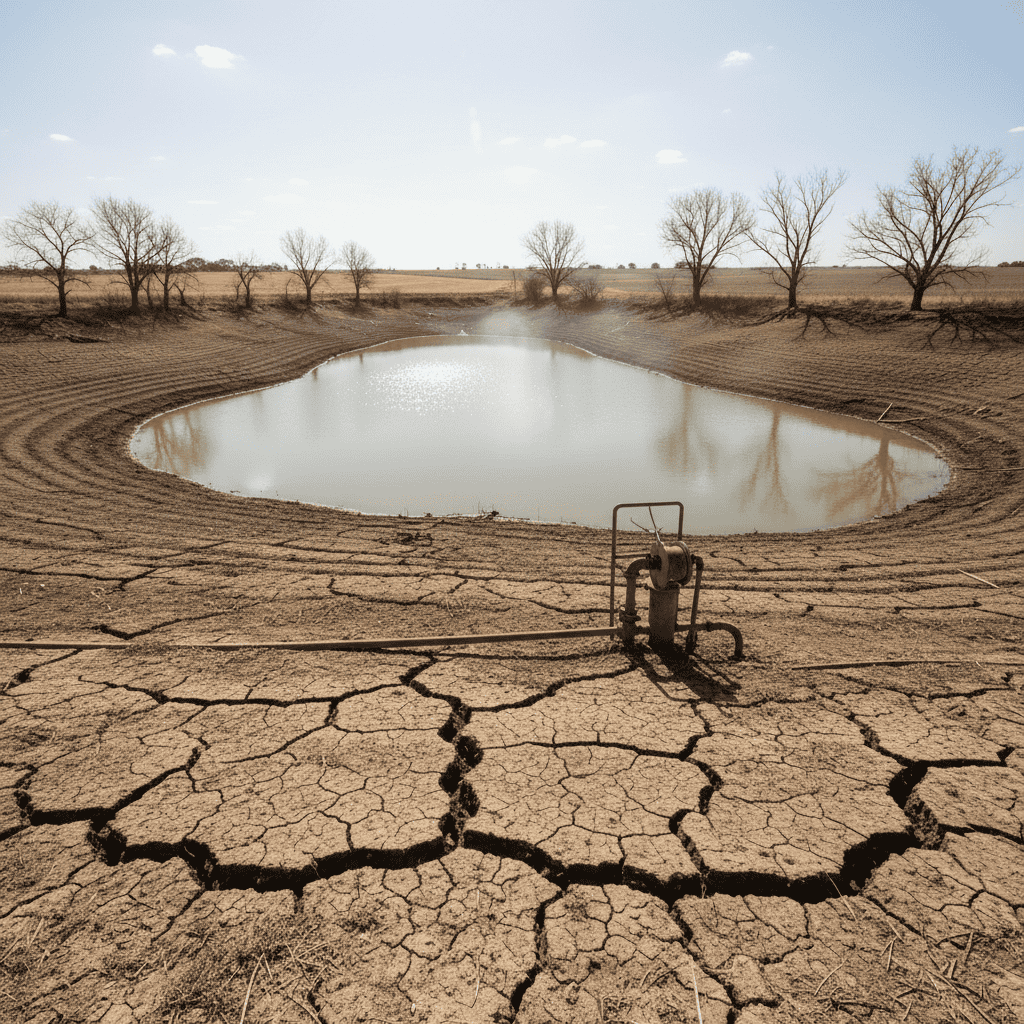
- Farm dams and reservoirs: Perhaps most consequentially, evaporation silently drains billions of litres from Australian water storage every year — often going unnoticed until a water deficit becomes critical.
The Economic and Environmental Cost of Evaporation
The costs of evaporation extend well beyond a lower water level in a dam.
In Australia, the scale of evaporative water loss is enormous. Research from the University of Southern Queensland estimates that 30–40% of total farm dam volume is lost to evaporation annually. Across Australia’s approximately 50,000 farm dams, this equates to an estimated 750 billion litres of water lost each year — water that has been captured, stored, and in many cases paid for through pumping and infrastructure costs.
For farmers operating in drought-affected regions, this loss is not merely an inconvenience. It directly increases irrigation demand, reduces the reliability of water supply for livestock, and forces costly water carting. In arid regions, evaporation can outpace inflow during dry periods, causing dams to fall to critically low levels even without prolonged drought.
Environmentally, excessive evaporation concentrates dissolved salts and minerals in remaining water, degrading water quality for both irrigation and stock use. It also contributes to soil moisture stress, increasing plant water demand and accelerating topsoil degradation.
For industry, evaporation is a significant cost in mining operations that rely on tailings dams and process water storage, where water loss affects both operational efficiency and environmental compliance. Evaporative cooling systems used in manufacturing and data centres similarly account for substantial water and energy consumption.
Evaporation & Energy
Evaporation is an energy-intensive process. When water evaporates, it absorbs latent heat from its surroundings — roughly 2,260 kilojoules per kilogram of water evaporated. This is why evaporation has a cooling effect (think of sweat evaporating from skin).
In industrial cooling towers and evaporative air conditioning systems, this principle is harnessed deliberately. However, it also means significant energy expenditure is embedded in every litre of water lost from a storage — energy used in pumping, treatment, and transport of water that ultimately evaporates rather than reaching its intended use.
There are also greenhouse gas implications. Water evaporation contributes to atmospheric water vapour, a potent greenhouse gas, and the energy consumed in replacing evaporated water through additional pumping and treatment adds to carbon footprints across agricultural and industrial operations.
Identifying Signs of Evaporation Issues
If you manage a dam, irrigation storage, or outdoor water supply, watch for these indicators that evaporation is causing significant loss:
- Unexplained water level decline: A steady drop in dam level during dry, hot, or windy conditions — without obvious leaks — points to evaporative loss.
- Water line stains: A residue or tide mark around the inside wall of a dam or tank above the current water level indicates where the surface previously sat.
- Salt concentration and white crusting: White crystalline buildup on dam walls, garden beds, or irrigation infrastructure indicates that evaporation is concentrating dissolved minerals in the remaining water.
- Plant stress and wilting: Crops or pasture showing wilting or yellowing during hot periods may be responding to reduced irrigation supply caused by dam water losses.
- Evaporation gauge readings: Installing a Class A evaporation pan near a dam provides measurable data on daily evaporation rates, allowing water managers to accurately account for losses in their water budget.
For a detailed look at measuring evaporation, see our guide to the 4 best methods to estimate evaporation levels.
How to Reduce Evaporation from Dams and Water Storage
Reducing evaporation is one of the most cost-effective water management strategies available to Australian farmers and property managers. Here are the most effective approaches:
Landscape Planning and Vegetation
Planting native shrubs and trees around dam banks can provide partial shade and act as windbreaks, reducing both solar radiation on the water surface and wind-driven evaporation. Buffer zones of dense vegetation also reduce runoff and improve water quality.
Mulching and Irrigation Efficiency
For irrigation water losses, applying mulch around crops and switching to drip irrigation dramatically reduces soil surface evaporation compared to overhead or flood irrigation methods. Water applied directly to root zones has far less exposure to evaporative conditions.
Rainwater Capture and Reuse
Collecting and storing roof and surface runoff reduces dependence on large open dams, which have high surface-area-to-volume ratios and correspondingly high evaporation rates.
Dam Covers and Floating Covers
Dam covers — purpose-built floating or suspended covers that physically block the water surface from the atmosphere — are the most effective solution for significantly reducing evaporation. A high-quality dam cover can reduce evaporative water loss by up to 90%, effectively eliminating the problem rather than just managing it.
Shade Ball Technology
Shade balls (also called aqua shades or water shade balls) are floating opaque spheres that cover the water surface, blocking sunlight and reducing both evaporation and algal growth. They are cost-effective for smaller storages and easy to deploy.
EvapCo’s Evaporation Management Solutions
At EvapCo, we specialise in custom evaporation management systems for Australian farms, mining operations, and infrastructure projects. Our dam cover solutions are engineered for Australian conditions — designed to withstand UV exposure, high winds, and the extreme temperature ranges experienced across the continent.
For a comprehensive breakdown of the leading options, read our guide to 5 methods of mitigating evaporation loss in dams, which compares dam covers, shade balls, floating wetlands, and other proven approaches.
Conclusion
Evaporation is a natural, unavoidable process — but its scale and economic impact on Australian agriculture, mining, and water infrastructure make it far more than a scientific curiosity. With up to 40% of farm dam volume lost every year, and billions of litres evaporating from Australian water storages annually, managing evaporation is a genuine business and sustainability priority.
Whether you are a farmer watching your dam level drop through summer, a water manager planning for drought resilience, or an infrastructure operator looking to reduce water consumption, understanding the evaporation process is the foundation of any effective response. The solutions exist — from simple landscape planning through to high-performance dam covers — and for most operations, the return on investment is compelling.
For more background on the science, visit our Introduction to Evaporation, or contact EvapCo to discuss a tailored evaporation management solution for your property.
Frequently Asked Questions About Evaporation
What causes evaporation to increase?
Evaporation increases when one or more of the following factors intensify: higher temperatures (which give water molecules more kinetic energy), lower relative humidity (dry air has greater capacity to absorb water vapour), increased wind speed (which removes saturated air from above the water surface), and greater exposed surface area (shallow, wide water bodies evaporate more rapidly than deep, narrow ones). In Australia, summer conditions combine all of these factors simultaneously, making evaporation rates highest between November and March.
How much water is lost from dams through evaporation?
Evaporative water loss from Australian farm dams is substantial. Research from the University of Southern Queensland estimates that between 30% and 40% of total farm dam volume is lost to evaporation each year. Across Australia’s estimated 50,000 farm dams, this amounts to approximately 750 billion litres of water annually — equivalent to many times the capacity of Sydney Harbour. In particularly hot and arid regions, a dam can lose several millimetres of depth per day during peak summer.
What are the best ways to reduce evaporation from a dam?
The most effective methods to reduce evaporation from a dam include: installing a purpose-built floating or suspended dam cover (which can reduce evaporation by up to 90%); deploying shade balls or floating covers to block solar radiation; planting windbreaks around the dam perimeter to reduce wind-driven evaporation; optimising dam design with a deeper, narrower profile to minimise surface area; and combining these approaches with efficient irrigation practices such as drip systems and mulching. EvapCo provides custom dam cover solutions designed specifically for Australian conditions — contact us to discuss your situation.
Pingback: Dam Evaporation Australia: What It Is & How To Stop It
Pingback: How To Estimate Evaporation From A Dam: 4 Proven Methods
Pingback: How To Reduce Evaporation Loss From Farm Dams: 5 Proven Methods - Evap.co